




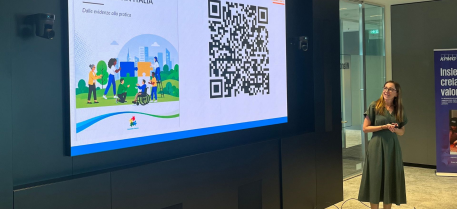
Research Presented in Collaboration with the University of Macerata
Corporate volunteering is no longer merely a corporate social responsibility initiative; it is increasingly evolving into a strategic tool for strengthening employee engagement, creating shared value, and reinforcing the relationship between companies and local communities.
To further explore this topic, as part of the Sodalitas Value Academy, the Sodalitas Foundation, in collaboration with KPMG and the University of Macerata, organized a meeting dedicated to corporate volunteering. The event provided an opportunity for discussion with member companies and featured the presentation of the main findings of a research project conducted in partnership with the University of Macerata.
The workshop also offered an opportunity to share concrete experiences developed by several companies affiliated with the Sodalitas Foundation. These case studies, together with others, were included in the research publication Corporate Volunteering in Italy: From Evidence to Practice, which is available here.
Corporate Volunteering: A Practice Increasingly Embedded in Corporate Strategies
The meeting was opened by Patrizia Giorgio, Senior Program Director of the Sodalitas Foundation, who introduced the topic by emphasizing how corporate volunteering is assuming an increasingly central role in organizations’ sustainability strategies.
During the meeting, Alberto Zanutto, Associate Professor of Business Organization at the Department of Economics and Law of the University of Macerata, presented the results of the research carried out by the Sodalitas Foundation in collaboration with the University of Macerata.
The study, which was developed through qualitative interviews with companies, employees, and non-profit organizations, highlights that the most effective volunteering programs are those that are fully integrated into a company’s culture and strategy, going beyond the scope of occasional initiatives.
Research Findings: Engagement, Skills, and Social Impact
The research shows that corporate volunteering delivers significant benefits for both individuals and organizations.
Among its most important impacts are increased employee engagement, the development of transferable skills, a stronger sense of belonging, and enhanced relationships among colleagues, often extending beyond roles, functions, and organizational hierarchies.
The data collected also demonstrate that volunteering promotes greater awareness of community needs and helps reactivate individuals’ civic engagement, creating new opportunities for collaboration between businesses and the non-profit sector.
Another key finding concerns the importance of building strong and long-lasting partnerships with non-profit organizations, paying close attention to the needs of local communities, and designing programs capable of enriching employees’ experiences while generating shared value for the entire organization.
Corporate Experiences: Comparing Models and Best Practices
The second part of the meeting was dedicated to corporate testimonials, presented by Renata Villa and Angela Straziota, Volunteer Directors of the Sodalitas Foundation. They introduced the collection of case studies developed as part of the project.
The experiences shared by Acque Bresciane, Intesa Sanpaolo, KPMG, and Sky Italia demonstrated how corporate volunteering can take many different forms while sharing several key characteristics: strong employee involvement, the ability to respond to local community needs, and a commitment to generating tangible and measurable social impact.
The testimonials confirmed that, when integrated into a structured and shared strategy, corporate volunteering can contribute not only to individual well-being and community development but also to strengthening corporate culture and enhancing companies’ ability to create long-term social value.