




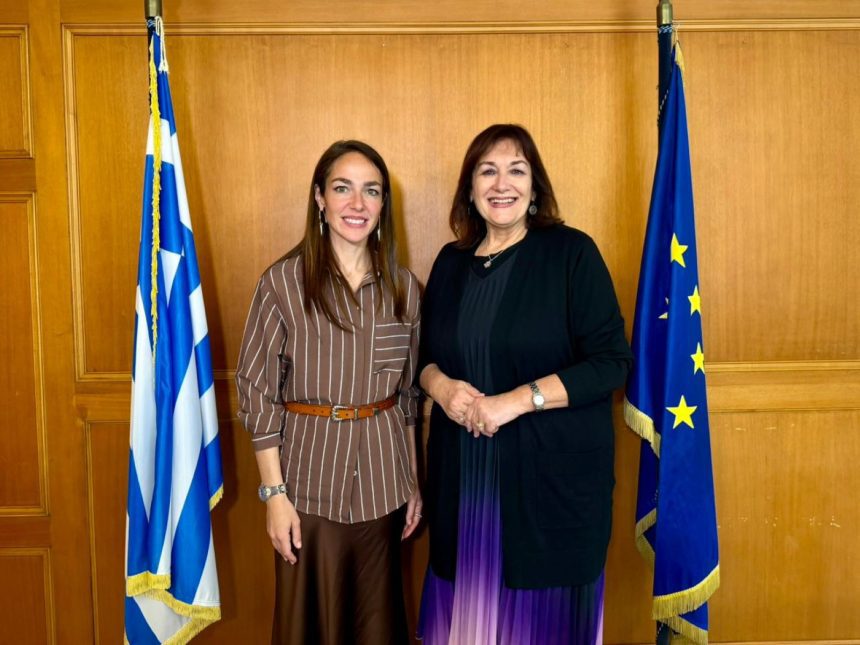
A working meeting was held on Thursday, April 23, 2026, between the Minister of Social Cohesion and Family, Domna Michailidou, and the European Commissioner for the Mediterranean, Dubravka Šuica, who is responsible for demographic issues. The meeting followed the Commissioner’s earlier discussion with Prime Minister Kyriakos Mitsotakis.
The discussion focused on the demographic challenges faced by both Greece and the European Union, at a time when demographic change is emerging as a top European priority.
The Minister presented in detail the pillars of Greece’s strategy, emphasizing the need for a more coordinated European approach, more effective use of available financial instruments, and the strengthening of regional cohesion. At the same time, the importance of the technical assistance provided to Greece through the OECD and the European Commission for the design of national policies was highlighted.
The Minister of Social Cohesion and Family, Domna Michailidou, stated: “We discussed with Ms. Šuica the demographic issue, an existential challenge that Europe is already facing, with fertility rates well below the replacement level. This is not just a simple crisis, but the most critical challenge for the future of the Union, as behind the relentless numbers lie young people who postpone starting a family because they feel they lack prospects. In response to this reality, Greece is leading the way with a coherent National Action Plan (2025–2035), which goes beyond fragmented measures and focuses on substance: from financial support and expanding access to housing, to strengthening employment and promoting work–life balance. Our plan follows life as it is and constitutes a practical model for European countries, demonstrating that addressing demographic challenges requires continuity, realism, and a common European strategy that will provide young people with stability. Ultimately, the demographic issue is a matter of trust. It is our responsibility to ensure that future generations have the future they deserve by creating an environment of security and social cohesion.”
From her side, Ms. Šuica noted:“The demographic issue is not only a matter of social policy, but a central element of the European Union’s economic strength and competitiveness. I would like to congratulate Greece on its highly ambitious ten-year national plan, which, with more than 100 actions, represents a strong commitment and demonstrates leadership. Particularly important is the emphasis placed by the Greek government on regional approaches, serving as an excellent example for the rest of Europe. We are entering a new reality of longevity and, through tools such as the Demography Toolbox, as well as the new Longevity Roadmap, we are ready to support Greece in transforming demographic changes into opportunities for prosperity for all generations.”
The meeting confirmed the willingness to further strengthen cooperation at the European level, with the aim of developing coherent and effective policies to address demographic challenges.