


By Anna Konstantinidi Apergi, Special Advisor – Diversity Charter Greece
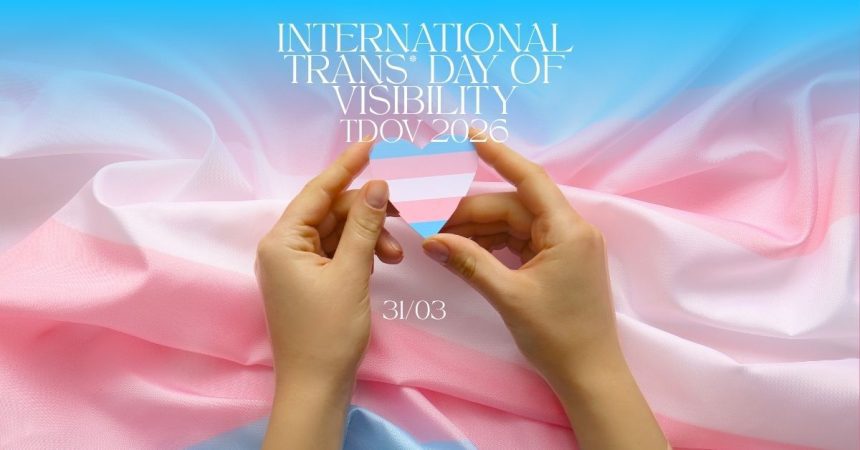
Trans Day of Visibility (TDoV), observed annually on March 31 around the world, is an initiative launched in 2009 to honor the struggles of trans activist Rachel Crandall and serves as a crucial reminder that transgender people still do not enjoy equal rights and freedoms that are taken for granted by other citizens.
At both the institutional and social levels, they continue to experience stigma, prejudice, marginalization, and a web of discrimination and exclusion based on their gender identity or expression. And this reality is neither accidental nor neutral; it is deeply political.
At the same time, there has been an alarming global rollback of transgender and broader LGBTQI+ rights. The challenge to the right to self-determination, the revival of biological and restrictive definitions of gender, and the normalization of hate speech create a dangerous environment, more broadly for human/individual rights.
Of particular concern is the fact that this regression is not limited solely to government policies or institutions, but now permeates parts of the feminist movement itself. When the existence of trans people is called into question, when the right to self-determination is undermined, and when stereotypes and exclusions are perpetuated, then we are not talking about feminism, but about a deconstruction of the very principles of equality and freedom that it espouses.
See also: Landmark ruling by the ECJ. It requires legal recognition of gender identity in all Member States
At the same time, recent international developments are also causing particular concern, such as the International Olympic Committee’s decision to exclude transgender and intersex individuals from women’s competitions by imposing strict biological and genetic criteria. A decision that does not ensure fairness in sports, but reinstates a dangerous biological definition of gender, raising serious questions regarding its compatibility with the principles of non-discrimination and human dignity.
These developments are not isolated incidents. On the contrary, they are part of a broader trend of regression, in which human and individual rights are being called into question and equality is becoming a negotiable concept.
On the occasion of International Trans Visibility Day, the government is once again called upon to take immediate action to eliminate discrimination and implement concrete measures to address the demands of the trans community:
1. The process of legal recognition of gender identity (Law 4491/2017) should be made an out-of-court procedure, with full respect for the self-determination of transgender individuals. Provision should be made for the recognition of transgender parents in their children’s civil registry records based on their gender identity, free access to the process without age restrictions, the explicit option of leaving the gender field blank for non-binary individuals, as well as provisions for transgender individuals with refugee status.
2. The full implementation of the World Health Organization’s decision (ICD-11), the depathologization and de-stigmatization of gender identity, and the guarantee of universal, non-discriminatory access to the healthcare system for transgender people. Full insurance coverage for gender-affirming procedures and equal access to adoption, surrogacy, and assisted reproduction.
3. The amendment of Article 62 of Law 4931/2022 to explicitly prohibit all “conversion” practices, by both professionals and non-professionals, as well as strengthening protection against discrimination in the healthcare sector through the Code of Medical Ethics.
4. Strengthening the framework for addressing hate speech, particularly when it is perpetrated by public figures, protecting human rights defenders, the explicit prohibition of hate speech within the Parliament, and the legal recognition of femicide.
5. The development of educational policies and programs to combat discrimination at all levels of education, with the aim of fostering a culture of equality and inclusion.
6. The inclusion of transgender individuals in the Ministry of Labor and Social Affairs’ special assistance programs for vulnerable groups and the establishment of a special allowance for transgender individuals over the age of 50.
7. The revision of Law 2734/1999 on sex work, with the aim of fully guaranteeing labor, social security, and welfare rights and providing effective protection against discrimination.
8. Institutional cooperation between the relevant ministries and LGBTQI+ organizations and specialized individuals/experts to develop inclusive policies.
Finally, I cannot fail to address the issue of the rise in hate speech and transphobic attacks, as well as the attempt to legitimize them by invoking “freedom of speech.”
The right to self-determination is a fundamental human and individual right. Human rights are not à la carte, nor can they be compartmentalized. The more we discuss them without an interdisciplinary approach and without inclusivity, the more we undermine their very foundations. And when this happens at a time when far-right rhetoric and Trumpism are gaining ground, it is not only the rights of transgender people that are at stake—our very democracy is at stake.
Because visibility is a right. And without rights, there is no democracy!