




Written by Kyriaki Papayatzoglou
The most serious news in the United States over the weekend was the killing of a 37-year-old American citizen in Minneapolis by federal agents. Alex Pretis is the second civilian to be killed in January, in a climate of intensified repression that the Trump administration presents as a policy of “security” and “order.”
Widely circulated videos show Preti already immobilized and in custody at the moment he is shot. Nevertheless, government officials rushed to adopt a narrative that portrayed him as a threat, attempting to retroactively legitimize the lethal use of force.
The gap between the evidence and the official version of events has sparked intense public reaction and serious questions about how the federal government handles violence, protest, and truth.
Second deadly attack in a month
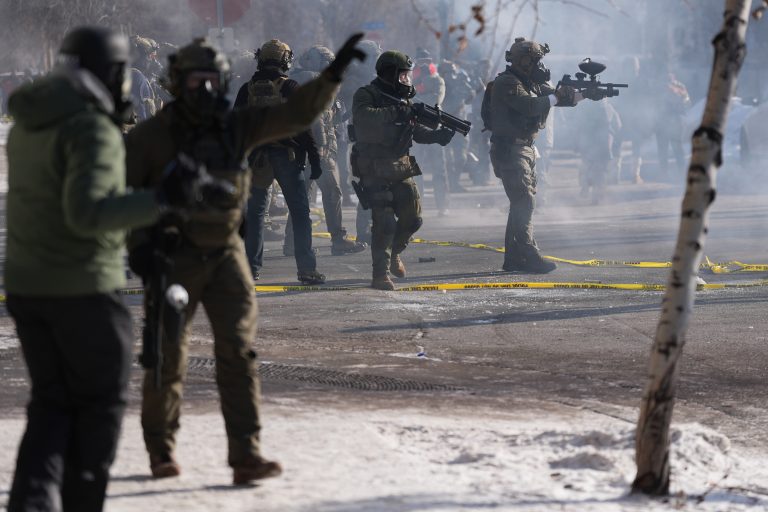
For the second time in a few weeks, federal agents shot and killed an unarmed civilian in Minneapolis and then restricted access to the scene, raising concerns about the transparency of the investigation.
The victim, 37-year-old Alex Preti, worked as a nurse at the city’s veterans hospital. On Saturday morning, he was recording the authorities’ actions on his cell phone and trying to help another protester when agents threw him to the ground and immobilized him. A few seconds later, he was shot repeatedly.
The government claimed that Preti posed a deadly threat. However, eyewitness footage shows that he never drew his weapon and had already been disarmed at the time he was killed.
His family publicly denounced the attempt to discredit his memory, demanding that those responsible be held accountable and that the truth be revealed.
Prety had no criminal record, was a US citizen and held a legal gun licence. The Minneapolis police chief stated that, based on the available evidence, Preti appeared to be exercising his constitutional rights: recording police activity and legally carrying a weapon.
When political power treats journalism as a threat
The Prety case clearly highlighted the role of journalism as an institutional counterweight to state power. Where there are independent journalists, visual evidence, and persistent questioning, it becomes more difficult to impose a one-dimensional, official narrative. This was also reflected in the White House.
During an official press conference, a journalist asked for an explanation of how the government’s version of events could be reconciled with videos showing an already immobilized citizen being shot dead. Instead of answers, a personal attack followed.
The spokesperson reacted aggressively, questioned the journalist’s motives, and used derogatory language, avoiding addressing the substance of the issue. This attitude reinforced concerns that the government views criticism not as an element of democratic accountability, but as a hostile act.
This incident is part of a broader pattern. In the same month, the FBI searched the home of a Washington Post journalist and confiscated personal work devices. Practices that are internationally associated with restrictions on press freedom are now also appearing within the US.
When political power chooses to clash with journalism, it not only restricts journalists — it restricts society’s right to know.
Democracy cannot function without independent information.
In an interview, New York Times publisher A.G. Sulzberger described how the Trump administration uses lawsuits, financial pressure, institutional tools, and exclusion from information to put pressure on the media.
As he noted:
- Targeting journalists undermines fundamental democratic principles,
- Self-censorship is becoming increasingly common due to fear of reprisals,
- Rights are only preserved when they are actively exercised and protected.
According to him, the New York Times did not bow to political pressure — and was vindicated institutionally.
Because all of this concerns diversity and inclusion.
The Preti case is not an isolated incident of police violence. It touches on the core issues of equality before the law, freedom of expression, and which rights are considered negotiable.
Inclusion is not just about recognizing identities. It is about ensuring that no individual—regardless of political beliefs, social status, or participation in protests—becomes a target of state arbitrariness.
At a time when “security” policies are being used to restrict rights and control narratives, journalism, solidarity, and collective memory remain fundamental acts of democratic resistance.