



By Kyriaki Papagiatzoglou
The strengthening of Germany’s far-right AfD is not simply another shift on Europe’s political map. When policies that challenge the rights of LGBTQ+ people, migrants, refugees and other social groups gain significant electoral legitimacy, the issue concerns Europe as a whole — and the values on which it was built.
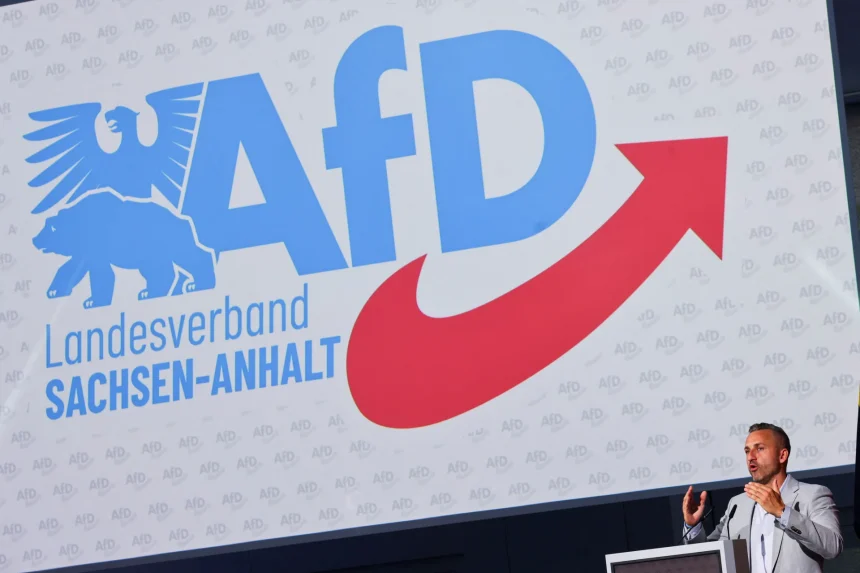
There are election results whose significance extends far beyond the borders of a single country. The strong showing of the AfD in Saxony-Anhalt is one such case.
And not simply because it is a far-right party. The AfD’s regional branch in Saxony-Anhalt has been classified by the state’s Office for the Protection of the Constitution as a confirmed right-wing extremist organisation. The real question, therefore, is what happens when views that until only a few years ago existed on the fringes of the political system move towards the centre of public debate and seek to be implemented as government policy.
For those who believe in human rights, diversity and inclusion, this development cannot be treated as an ordinary shift in political power.
First, the language changes
Major setbacks in human rights do not necessarily begin with the abolition of a right. They often begin with a change in language.
When one form of family is described as “normal”, the inevitable question is who is being placed outside that definition of normality.
When diversity is described as an “ideology”, when terms such as “Trans-Kult” or “Genderideologie” are used, and when state support for different ways of life is presented as something that should be restricted, we are no longer dealing simply with a different conservative approach.
A political vocabulary is being created in which some people are portrayed as less compatible with society than others.
And language has consequences. Because what appears today as rhetoric can tomorrow become the basis of public policy.
LGBTQ+ rights under question once again
The AfD’s positions are particularly revealing.
The traditional family of father, mother and children is placed at the centre of social policy, while the party opposes state promotion and funding of “alternative lifestyles”.
In Saxony-Anhalt, restrictions on the use of the rainbow flag have even entered the political agenda. At the federal level, the AfD calls for the repeal of Germany’s Self-Determination Act and adopts particularly aggressive political language on issues affecting transgender people.
But the issue goes beyond any single policy or piece of legislation.
Europe’s experience has shown that rights do not evolve in only one direction. Achievements that took decades to secure can be challenged, and social groups that fought for years to gain visibility can once again find themselves at the centre of political battles over their very existence and equality.
And it is not only about the LGBTQ+ community
This is perhaps the most important point.
Policies of exclusion rarely remain confined to a single social group.
The AfD’s agenda includes hardline policies on migration and deportations, proposals for separate classes for refugee children, restrictive approaches towards the presence of Islam, as well as proposals that have sparked concern regarding the educational inclusion of children with disabilities.
Above all, there is the concept of “remigration”, which has become a central element of the debate surrounding Germany’s far right.
But when politics begins to divide people into those who “belong” more and those who “belong” less, the problem ceases to concern one particular minority.
It concerns the very meaning of equality.
Inclusion is not a luxury for the “good times”
In periods of economic insecurity, migration pressures, war and declining social trust, there is a genuine danger: the protection of minorities can begin to be portrayed as a secondary issue.
As if inclusion were a luxury that society can afford only when everything is going well.
The opposite is true.
The value of human rights is proven precisely during difficult times. That is when we discover whether a democracy genuinely protects all its citizens or only those who form the majority.
Inclusion does not mean that everyone must agree. It means that a person’s dignity, safety and fundamental rights cannot depend on their sex, gender identity or expression, sexual orientation, origin, religion or disability.
A warning sign for Europe
This is why developments in Germany should be understood as a broader warning sign for Europe.
What is most concerning is not simply the existence of extreme political positions. Extreme political forces have always existed in Europe.
The critical shift occurs when their rhetoric becomes normalised. When words and ideas that once triggered democratic alarm bells are repeated so often that they gradually cease to shock. When other political parties begin adopting parts of their language in an effort not to lose voters. And when social groups become convenient targets onto whom far more complex social problems can be projected.
That is the point at which this debate concerns all of us.
Because human rights are not always lost overnight. They can be gradually eroded: first through language, then through the social acceptance of exclusion, and finally through laws and public policy.
Europe must remember what it wants to be
Post-war Europe was built upon a fundamental promise: that human dignity does not depend on who you are, where you come from or whom you love.
That promise cannot be taken for granted, nor is it irreversible.
The answer to the rise of the far right cannot be to silence its voters or deny the real social problems that fuel anger and insecurity. A democracy has a responsibility to listen to those concerns and provide credible answers.
But there is a red line: no social or economic problem can be solved by taking dignity and rights away from another group of people.
For those who defend inclusion and diversity, therefore, developments in Germany are not a reason for panic. They are a reason for vigilance.
Because an inclusive society is not judged by how comfortable the majority feels within it.
It is judged by how safe a person who is different can feel within it.