




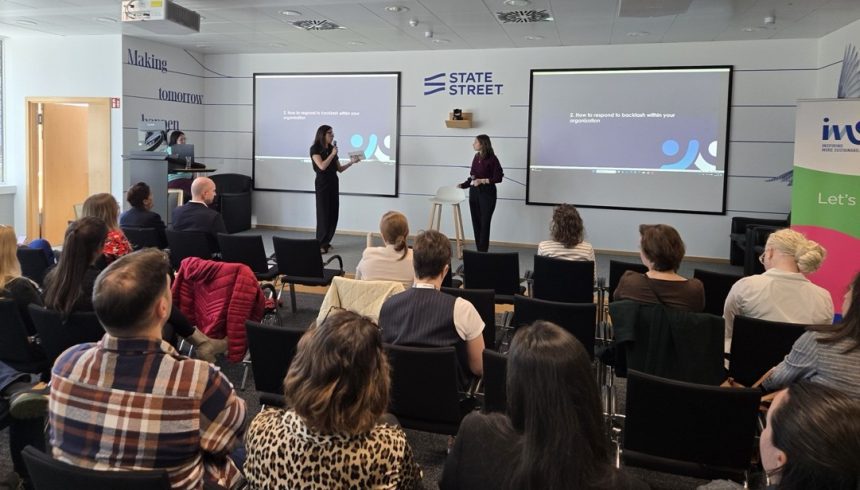
The French Association for Diversity Managers (AFMD) was invited to speak at an event organised by the Diversity Charter Luxembourg, titled “The business case for diversity and inclusion: from consensus to adversity – arguments to counter the backlash.”
If the AFMD works with French stakeholders in the equity, equality, diversity and inclusion (EEDI) ecosystem, it also maintains strong connections with international actors. Among its longest-standing partners, with over ten years of collaboration and shared expertise, is Inspiring More Sustainability (IMS) in Luxembourg.
Like the AFMD, IMS Luxembourg brings together EDI and CSR managers from a wide range of organisations and coordinates the Diversity Charter Luxembourg, making it a key player in the country.
On 19 March, IMS Luxembourg organised a meeting for Diversity Charter signatories: “The business case for diversity and inclusion: from consensus to adversity – arguments to counter the backlash.” The AFMD was invited to present its work on the topic and was represented by Andrea Hummel, Community Engagement Officer.
Taking a step back: why are EDI programmes facing resistance?
One section of the AFMD’s forward-looking overview highlights the key trends affecting the EDI sector and fuelling backlash:
- Economic uncertainty and increasing budgetary pressures
- A French economy structured around large organisations and oriented towards international markets, making multinational companies dependent on developments in the countries where their headquarters are located
- Growing political polarisation and the rise of far-right populist parties in Europe, leading to the politicisation of EDI issues (sometimes framed as “woke”)
- The emergence of a “diversity fatigue” narrative
Legitimising EDI: the business case vs. EDI as an organisational strategy
Business case arguments are often used to defend and legitimise EDI policies by linking more “diverse” teams to improved performance, particularly in terms of creativity and innovation.
However, relying solely on these arguments to support EDI programmes presents certain pitfalls, especially in times of backlash. For instance, there is a risk of reducing individuals to mere resources and essentialising them. Similarly, the sustainability of EDI programmes may become contingent on serving an organisation’s economic interests, and therefore be called into question when profits decline.
On the other hand, embedding EDI issues within an organisational strategy requires defending EDI programmes for specific reasons (employer branding, risk management, talent attraction and retention, etc.), while also strengthening their coherence by aligning them with the organisation’s strategic objectives and integrating them into HR systems and decision-making processes.
In this way, EDI becomes intrinsically linked to “how things are done.”
For all these reasons, combining business case arguments with the integration of EDI into organisational strategy enables organisations to become more resilient in the face of backlash.