



In order to promote the social component of sustainable practices within the business operations of our signatories, HR BCSD as the holder of the Diversity Charter Croatia already started conducting a variety of activities, trainings and education in the first three months of 2026.
One of the core business practices of HR BCSD, as the holder of the Diversity Charter Croatian under which the Alliance for Gender Equality operates, lies in the field of Diversity & Inclusion (D&I). In this context, we deliver a range of training programs focused on sustainability, including sustainable business operations, while also emphasizing their connection to D&I, as well as responsible and supportive practices toward employees.
The following activities are those we conducted so far in the D&I field in the year 2026.
One of the educations, held annually, is WIC, (Workplace Inclusion Champion) whose 5th cycle is currently on-going. It has been developed and promoted byDiversity Charters Croatia, Slovenia and Romania with the support of the European Commission. This education in forms of blended learning consists of 9 modules (Sustainability, Mentoring, Communication, Gender Equality, Disability, LGBTQI+, Age Diversity, Mental Health and Intersectionality). The aim of this project is to equip the participants with the necessary tools, skills and knowledge to tackle diversity in work place. It teaches businesses how to implement D&I in a strategic way in their business operations by building inclusive workplace cultures. The education consists of various teaching materials and brings together experts in different fields, who contribute their knowledge and experience.
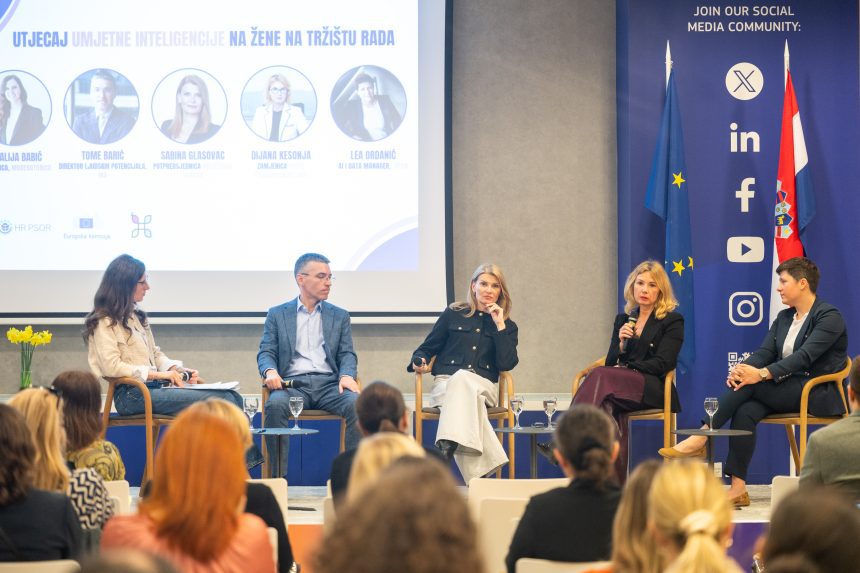
On 6th of March DC Croatia / HR BCSD and European Commission Representation held a Forum with the aim of marking International Women’s Day and opening a discussion on theImpact of Artificial Intelligence on Women in the Labor Market.The Forum was attended by various experts who contributed to the topic from different perspectives such as legislative, business, technological and institutional. Forum was moderated by Katarina Plecas, DCC manager and participants of this conversation were Mirjana Matešić, Director of HR BCSD, Judita Cuculic Zupa, Senior Economic Advisor at the European Commission Representation, MEP Marko Vesligaj, Vice-Chair of the Committee on Women’s Rights and Gender Equality, who called in in the form of a video message from Brussels, Sabina Glasovac, Vice-President of the Croatian Parliament, Tome Baric, HR Manager in INA Group, Dijana Kesonja, Deputi of Ombudswoman, Lea Ordanić AI & Data Manager, Span, and lawyer Natalija Babic who also moderated the panel which focused on the topic Digital inequality: the impact of artificial intelligence on women in the labor market.
In conclusion, the panel emphasized that artificial intelligence in itself is neither a positive nor a negative force, but its social impact will depend on the ways in which we develop and apply it. Policies, education systems and business practices need to be actively shaped to ensure that digital transformation contributes to greater equality, rather than deepen existing inequalities.
Project CAREvolution is a project aimed at revolutionizing gender-sensitive work-life balance through a comprehensive focus on employee well-being and mental health. This project was implemented by partners: the University of Maribor, IPES Maribor, the Slovenian Diversity Charter, HR PSOR/Croatian Diversity Charter and the Forum for International Communication (FIC) Foundation from Romania, with co-financing from the European Union. It focuses on fair responsibility division through means of education with the main objectives being enabling access to tools for employees and employers to learn about gender norms and promote equal care roles; providing support to managers and national authorities in the design and implementation of gender-sensitive policies; and by raising public awareness of the benefits of achieving a balanced and inclusive work environment. Additionally, by encouraging greater involvement of men in family life and informal care, the CAREvolution project promotes significant social changes that benefit individuals, businesses and communities.