




Translation/Editing: Anna Konstantinidi Apergi, Special Advisor – Diversity Charter Greece
Europe’s independence is about protecting our freedoms. The freedom to make our own decisions. To speak openly. To move freely across the entire continent. The freedom to vote. To love. To pray. To live in a union of equality. (Ursula von der Leyen, State of the Union Address 2025).
A truly inclusive society empowers and harnesses the potential of all citizens. That is why the European Commission has placed equality at the heart of its agenda, striving to build a union of equality where all people can live free from discrimination.
To support this goal, the Commission has adopted a comprehensive set of equality strategies that create the conditions for all individuals to live, thrive, and lead, regardless of differences based on gender, national or ethnic origin, religion or other beliefs, disability, age, expression, identity, gender characteristics, and sexual orientation. These include:
- LGBTQI+ Equality Strategies for the periods 2026–2030 and 2020–2025.
- Gender Equality Strategies 2026–2030 and 2020–2025,
- Strategy on the Rights of Persons with Disabilities 2021–2030,
- EU Action Plan against Racism 2020–2025,
- EU Strategy against Racism 2026–2030,
- EU Strategic Framework on Roma, Equality, Inclusion, and Participation 2020–2030
See also: Landmark ruling by the ECJ. It requires legal recognition of gender identity in all Member States
The right to be yourself
In the EU, discrimination on any grounds (gender, national or ethnic origin, religion or other beliefs, disability, age, gender expression, gender identity, sex characteristics, and sexual orientation) is prohibited by law. However, for many people, this remains a daily reality. To ensure that the fundamental rights to equality and non-discrimination are upheld, the European Commission continually proposes new policies and initiatives focused on promoting equality and inclusion.
A continent where you can aim as high as you want
The EU aims to become a continent where everyone can choose whatever path they want in life, free from violence and gender stereotypes.
Gender Equality
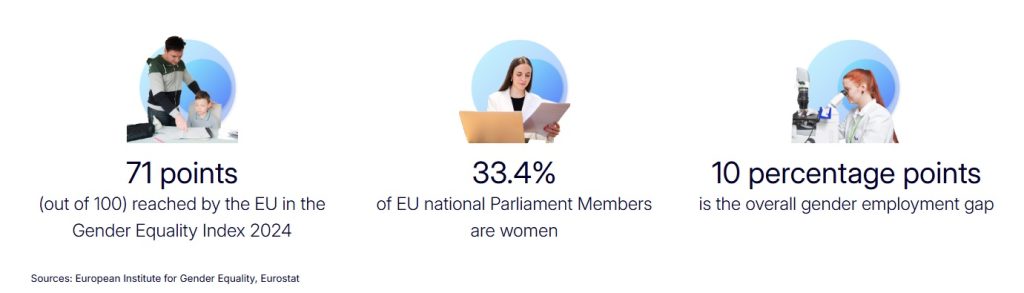
With regard to gender equality, EU countries have made significant progress, including through the promotion of common legislation and the integration of gender equality perspectives into various policy areas.
However, EU countries are still far from achieving full gender equality, and progress is slow. Gender-based violence remains widespread. In the labor market, women are overrepresented in lower-paying sectors and underrepresented in decision-making positions. On average, they still earn nearly 13% less per hour than men. Research shows that women generally perform more household chores than men. Gender stereotypes, which influence both women and men, are a key cause of these inequalities.
Building on the previous five-year strategy, the Commission launched a new gender equality strategy in 2026, with the aim of accelerating progress toward gender equality across the EU.
A continent where you can love whomever you want
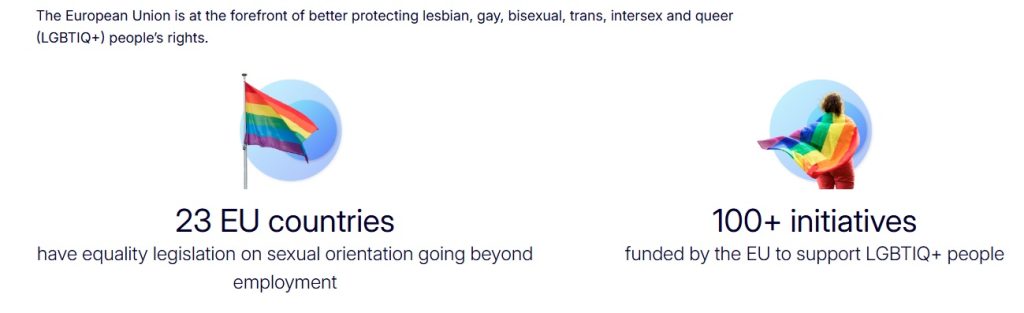
Despite our efforts to allow everyone to be who they are and love whomever they choose, LGBTQI+ people often face discrimination. A survey conducted by the European Union Agency for Fundamental Rights (FRA) in 2023 showed that discrimination based on sexual orientation or gender identity remains high. Harassment, bullying, and violence are higher than before. The same survey found that 55% of LGBTQI+ people surveyed have experienced harassment because they are LGBTQI+.
Building on the progress made under its first strategy for LGBTQI+ equality, the Commission has launched its Strategy for LGBTQI+ Equality 2026–2030, with the aim of continuing to promote equality and non-discrimination, protecting and empowering LGBTQI+ individuals, and fostering their participation in society.
A continent where you can be yourself
Combating Racism
We are “united in diversity” on a continent that is home to many different cultures, traditions, and languages.
But for the EU to live up to its motto, we must constantly combat racism and xenophobic movements, including the fight against anti-Semitism and anti-Muslim hatred.
The latest Eurobarometer survey on discrimination shows that nearly two out of three citizens still consider racial discrimination to be a widespread problem in their countries.
In recent years, the EU has made progress in combating racism, focusing in particular on removing the barriers created by racial discrimination and on mainstreaming anti-racism efforts across all relevant EU policies. Building on the Action Plan against Racism (2020–2025), the Commission has strengthened its approach through a new anti-racism strategy, stepping up action against all forms of racism.
Greater Inclusion for People with Disabilities
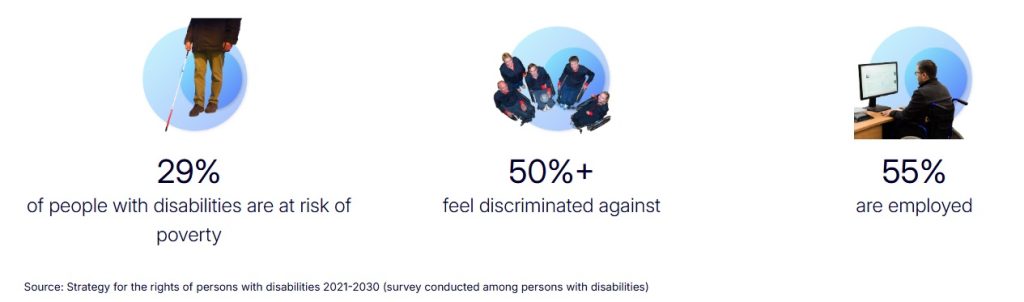
Despite the progress made so far, people with disabilities continue to face significant barriers in our society. The Strategy on the Rights of Persons with Disabilities 2021 -2030 aims to improve the lives of these individuals and ensure that they can enjoy their rights and participate fully in society and the economy on an equal basis with non-disabled people.
The Commission has taken stock of the new needs and challenges that have emerged since 2021, such as the need for preparedness in times of crisis and the growing use of artificial intelligence, which presents both challenges and opportunities. As a result, the strategy was reinforced in May 2026, among other things to raise its ambition and focus on better implementation.
According to the Strategy, an Employment Package for People with Disabilities was adopted in 2022. Given that only half of the 42.8 million people with disabilities in the EU are employed, such initiatives provide guidance to employers and public authorities, while also helping more people with disabilities access the labor market.
In recent years, a number of EU regulations have also been enacted to make the EU more accessible to people with disabilities, including:
- European Accessibility Act, covering products and services
- and the Web Accessibility Guidelines
Other initiatives include:
- European Disability Card and European Parking Card,
- supported housing
- social services
Equality, Inclusion, and Participation of the Roma
Roma people constitute the largest ethnic group in Europe. Of the 10 to 12 million, approximately 6 million are EU citizens or residents.
Although discrimination is prohibited in the EU, many Roma people continue to be victims of prejudice and social exclusion.
In 2020, the Commission launched a 10-year plan to support equality, inclusion, and participation of the Roma community in the EU, in which it set out its goals for 2030, including:
- a reduction of at least half in the percentage of Roma who have experienced discrimination
- reducing the poverty gap between the Roma and the general population by at least half
- a decrease in the percentage of Roma children attending segregated elementary schools
- reducing the gap in life expectancy
The Working Group on Equality
All five strategies for the Equality Union combine targeted measures (such as equality legislation or specific awareness-raising activities) with efforts to mainstream equality into other policy areas.
To help integrate equality into all policy areas, the Commission has established a Special Working Group.
Related links:
Equality and Inclusion: https://commission.europa.eu/topics/equality-and-inclusion_en
Statistics on equality: https://ec.europa.eu/eurostat/web/equality-non-discrimination/overview
European Institute for Gender Equality (EIGE): https://eige.europa.eu/
European Union Agency for Fundamental Rights (FRA): https://fra.europa.eu/en
Addressing discrimination: https://commission.europa.eu/strategy-and-policy/policies/justice-and-fundamental-rights/combatting-discrimination/racism-and-xenophobia_en
Commission actions to achieve gender equality: https://commission.europa.eu/topics/equality-and-inclusion/equality-and-inclusion-key-actions/actions-gender-equality_en
Protecting the rights and safety of LGBTQI+ individuals: https://commission.europa.eu/topics/equality-and-inclusion/equality-and-inclusion-key-actions/actions-lgbtiq-equality_en
European Action Plan against Racism 2026–2030: https://commission.europa.eu/news-and-media/news/new-anti-racism-strategy-pushes-equality-all-2026-01-20_en
European Strategy on the Rights of Persons with Disabilities 2021–2030: https://commission.europa.eu/strategy-and-policy/policies/justice-and-fundamental-rights/disability/enhancing-strategy-rights-persons-disabilities-2030_en
Commission actions to promote equality, inclusion, and participation of the Roma in the EU: https://commission.europa.eu/strategy-and-policy/policies/justice-and-fundamental-rights/combatting-discrimination/roma-eu/roma-equality-inclusion-and-participation-eu_en
European Commission Working Group on Equality: https://commission.europa.eu/topics/equality-and-inclusion/equality-and-inclusion-key-actions/task-force-equality-european-commission_en
Source: European Commission