





Women working across the European Union lose an estimated €358 billion every year because of the gender pay gap, amounting to nearly €3,900 per woman annually. According to Eurostat, women’s gross hourly earnings are, on average, 11.1% lower than those of men. This means that for every €100 earned by a man in the European Union, a woman earns only €88.90.
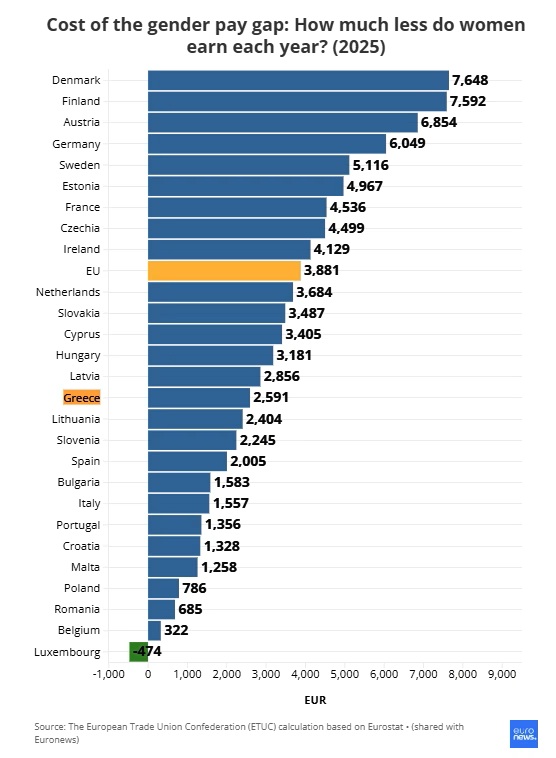
On an annual basis, the gap becomes even more evident. According to estimates by the European Trade Union Confederation (ETUC), based on Eurostat data, the average woman earns almost €3,900 less per year than her male counterpart across the EU. This means that the 92.5 million women employed in the European Union collectively lose more than €358 billion annually.
Member States’ Delay
«The cost of implementing pay transparency measures is small for businesses, but this analysis shows that the inaction of national governments will cost working women billions in lost wages," said ETUC General Secretary Esther Lynch.
The EU Pay Transparency Directive applies to companies employing at least 100 workers. Therefore, this estimate reflects the female workforce covered by the Directive, which includes 43 million women. Luxembourg is the only EU country where women earn more than men, receiving approximately €474 more per year. The average working woman loses more than €5,000 annually in Finland (€7,592), Austria (€6,854), Germany (€6,049), and Sweden (€5,116), according to 2025 data.
Annual income losses also exceed the EU average (€3,881) in Estonia (€4,967), France (€4,536), Czechia (€4,499), and Ireland (€4,129), with all four countries recording losses above €4,000. Estimated annual losses amount to €3,684 in the Netherlands, €3,487 in Slovakia, €3,405 in Cyprus, €3,181 in Hungary, €2,856 in Latvia, €2,591 in Greece, €2,404 in Lithuania, €2,245 in Slovenia, and €2,005 in Spain. The lowest loss is recorded in Belgium, at just €322, while Romania and Poland also report annual losses below €1,000. Among the EU’s four largest economies, Italy records the lowest annual loss, at €1,557.
The EU Pay Transparency Directive Could Make a Difference
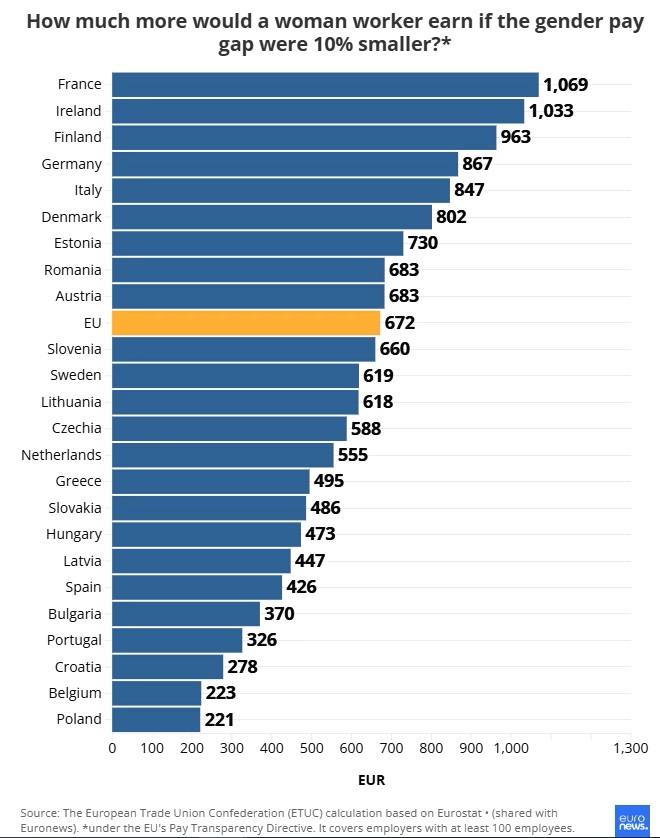
The EU Pay Transparency Directive aims to increase wage transparency and reduce the gender pay gap. It was due to be transposed into national law by 7 June 2026, but most Member States failed to meet the deadline. «This is completely unacceptable, as women have already endured decades of pay discrimination. The culture of pay secrecy, which allowed male-dominated boards to maintain discriminatory pay practices for so long, has now come to an end," Lynch stated. According to ETUC estimates, the Directive could have a significant impact. Even a 10% reduction in the gender pay gap would allow the average working woman in the EU to earn approximately €672 more per year.
In Greece, a working woman would earn €495 more annually, which remains well below the EU average. The largest annual increase would be recorded in France (€1,069), followed by Ireland (€1,033). Working women would also see higher annual earnings in Finland (€963), Germany (€867), Italy (€847), and Denmark (€802). The smallest annual increase would be observed in Poland, at €221, reflecting the country’s comparatively smaller gender pay gap.
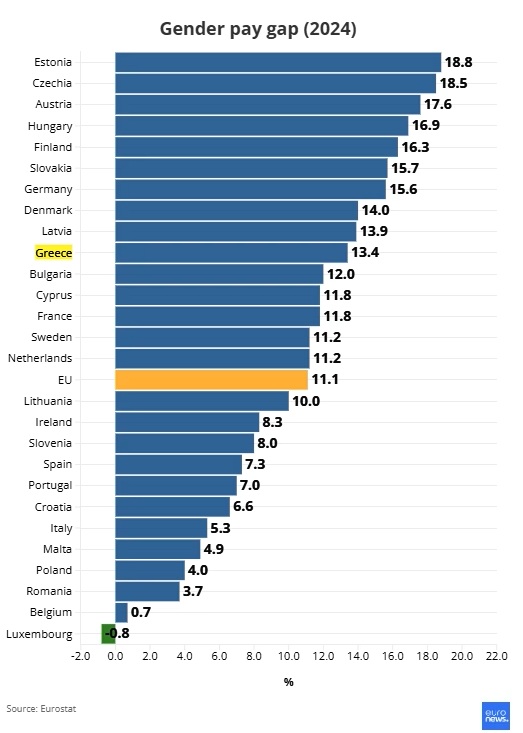
ETUC Deputy General Secretary Isabelle Schömann also stated that any government continuing to avoid its legal obligation to implement the Directive should expect to face legal action. Across the European Union, the gender pay gap varies considerably, ranging from -0.8% in Luxembourg to 18.8% in Estonia.