



By Anna Konstantinidi Apergi, Special Advisor – Diversity Charter Greece
Cities are not neutral. Every political choice, every public space, every service, and every decision made by local government directly affects which people feel visible, safe, and equal within the urban fabric.
In an era of profound social, demographic, and environmental change, the need for cities that are people-centered, inclusive, safe, and resilient is an institutional, social, and democratic imperative.
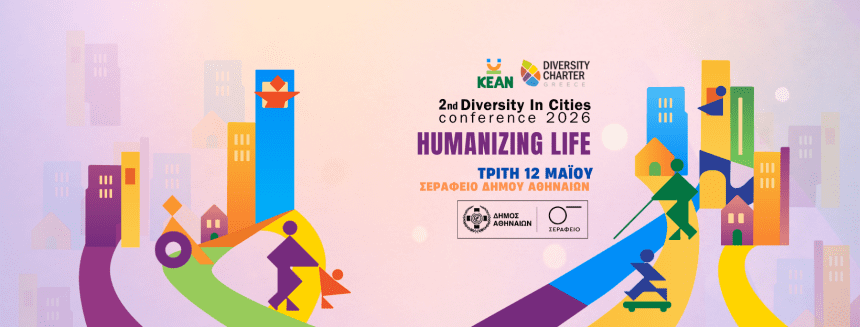
With this vision in mind, the 2nd Diversity in Cities Conference 2026, titled “Humanizing Life,” returns on Tuesday, May 12, at the Serafio of the Municipality of Athens, aiming to open a meaningful dialogue on the role of cities and local government in shaping societies that have room for everyone.
https://diversity-charter.gr/diversity-in-cities-conference-2026/
The conference highlights, that cities are not just streets, buildings, and infrastructure. They are the people who live in them. People of different ages, genders, ethnic backgrounds, religions, disabilities, gender identities, sexual orientations, socioeconomic statuses, and life experiences. And it is precisely this diversity that determines the sustainability and democratic nature of a modern city.
See also: Landmark ruling by the ECJ. It requires legal recognition of gender identity in all Member States
The European Union has repeatedly emphasized the importance of equality and inclusion at the local level. The European Commission, through the “Union of Equality Strategy,” the European Framework on the Rights of Persons with Disabilities 2021–2030, the European Strategy for Gender Equality, as well as the European Strategy for LGBTQI+ Equality, calls on Member States and local authorities to develop policies that guarantee equal access, participation, and representation for all citizens.

At the same time, the European Union Agency for Fundamental Rights notes that local authorities are the institutions most directly responsible for implementing human rights in citizens’ daily lives. From accessibility and housing to health, education, and participation in public life, cities are called upon to play an active role in combating discrimination and strengthening social cohesion.
Δηλώστε συμμετοχή εδώ: https://docs.google.com/forms/d/e/1FAIpQLSf-npEjq79a744iZFLhndc93XoFl-k40mgOaGVjlQzC_Wr9Kw/viewform?usp=send_form
“Humanizing Life” is designed precisely to address this need, to demonstrate how inclusion can be transformed from a theoretical concept into practical policy and everyday practice.
Through thematic discussions and presentations by elected officials, academics, scientists, civil society organizations, and professionals, the conference will shed light on issues such as:
- diversity in cities,
- accessibility and disability,
- health and social support,
- equality and representation,
- the creation of safe and sustainable communities, and,
- the need for public policies that put people first.
Local government is now on the front lines of social challenges. It is no longer enough for cities to be “functional.” They must be humane. They must listen, protect, include, and create conditions for a dignified life for every person, without exception.
View the conference program here: https://diversity-charter.gr/diversity-in-cities-conference-2026/
Inclusion starts in the neighborhood It starts with whether a public space is accessible. Whether a person feels safe expressing their identity. Whether a municipality’s services are provided equally to everyone, and whether citizens feel that their city sees them, listens to them, and values them.
The 2nd Diversity in Cities Conference 2026 is an open invitation to elected officials, local government leaders, professionals, organizations, academics, and all active citizens to participate in a dialogue concerning the future of our cities and, ultimately, the quality of our democracy.
Because cities thrive when they are designed for everyone, without exception or exclusion!
Because the right to inclusion is the right to the city itself!