




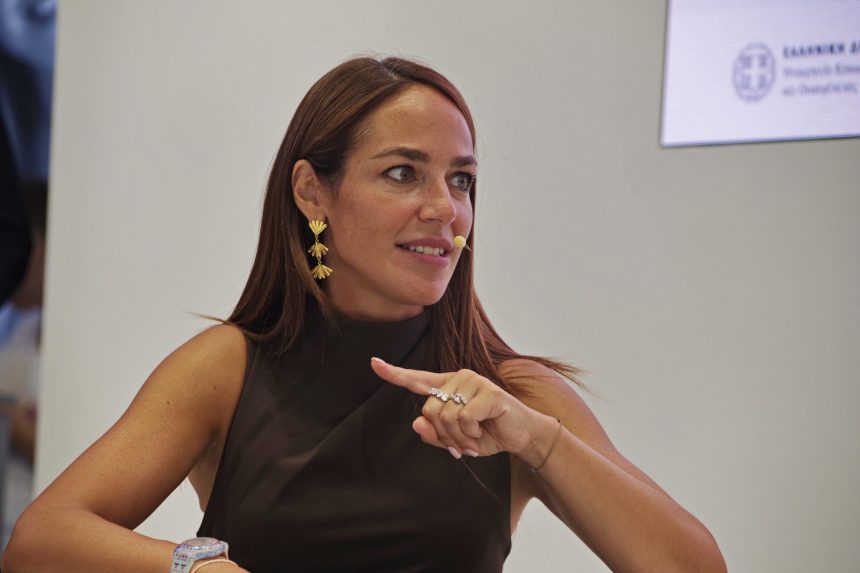
The Minister of Social Cohesion and Family, Domna, spoke about the need for a society that leaves no one behind, but invests in dignity, equality, and meaningful support for citizens, Minister of Social Cohesion and Family Domna Michailidou noted while speaking on ANT1’s “Good Morning Greece” program.
The discussion highlighted a series of initiatives aimed at strengthening social cohesion, with an emphasis on groups that are often marginalized: people with disabilities, the elderly, families with young children, and households facing financial difficulties.
The focus was on the new unified food assistance system, which aims to replace older, more fragmented practices by offering a fairer and more functional approach. With a budget of 400 million euros, the aid is directed directly to beneficiaries via vouchers, allowing them to choose the basic goods they need themselves. This change is not only about speed and efficiency, but primarily about restoring dignity—as citizens are no longer treated as passive recipients of aid, but as active managers of their daily lives.
The new system is directly linked to the Guaranteed Minimum Income, expanding the safety net and ensuring that access to basic food is a right, not a privilege. At the same time, it is accompanied by social inclusion measures, recognizing that poverty is not only an economic issue but also a matter of social exclusion.
Particular emphasis was also placed on digital empowerment, an area directly linked to the modern concept of equality. Through the “Everyone Digital – Digital Empowerment and Participation for All” program, people over 65 and people with disabilities are given the opportunity to acquire skills that are now essential for daily life—from accessing public services to communication and social participation. At a time when digital exclusion can lead to deeper isolation, such initiatives serve as a bridge to inclusion.
The nationwide expansion of the “Neighborhood Nannies” program is part of this same effort to support daily life, an initiative that addresses the real needs of modern families. The program supports parents with young children by offering financial assistance for their care by certified caregivers—including family members such as grandparents. In this way, the value of different forms of care is recognized and reinforced, while at the same time facilitating a balance between work and family life.
Finally, the discussion of school meals highlighted the importance of everyday policies with a profound social impact. For the 2025–2026 school year, the program now covers nearly one in two elementary school students, offering not only nutritious meals but also a sense of equality within the school community. School meals serve not only as support for families facing financial difficulties but also as a tool for inclusion, socialization, and fostering healthy habits for all children, regardless of their social background.
These interventions form part of a broader vision: a society that does not limit itself to providing aid, but actively invests in inclusion, autonomy, and the equal participation of all. In this direction, social policy becomes a tool for empowerment—and not merely for managing need.